Saturday, January 31, 2004
 Wisconsin Sunset
, Photo (c) Jim Doty, Jr.
MOZILLA FIREBIRD
I posted some comments on Mozilla Firebird on January 1, 2004 and urged folks to consider trying the latest version of this web browser. It is much faster than Microsoft's Internet Explorer and I really like right clicking to open links in tabs rather than new windows. All of my "open" pages are across the top of my browser window in a neat row of tabs; and I can quickly jump back and forth just by clicking the tabs. This makes editing between sites much faster. I can still open new links in new windows if I choose.
WebMonkey just posted and article on Mozilla and Firebird yesterday (January 30, 2004). If you are looking for something better, faster, and safer than Internet Explorer, it is worth reading the WebMonkey article. You can also go back and read my January 1, 2004 article.
Thursday, January 29, 2004
NEW GOODIES FROM CANON
Canon has announced two new lenses and one new camera body today.
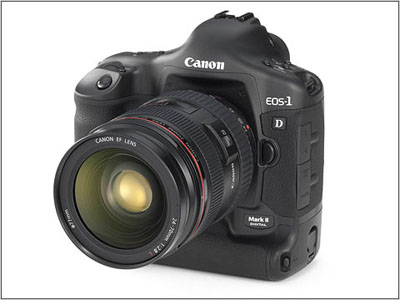
EOS-1D Mark II
This new camera body has an 8.2 megapixel sensor (almost twice as many as the EOS 1D at 4.2 MP) but the same sensor dimensions as the 1D for the same FOV (field of view) crop of 1.3.
It shoots at up to 8.5 frames per second with an image buffer of 40 frames in jpeg mode. This speed demon is obviously targeted at the Nikon D2H.
It has ISOs (digital "film speeds") from 50-3200, more than the EOS-1D. Images from the CMOS sensor are processed with new DIGIC II technology.
You can read a preview at DPReview and read the Canon press release.
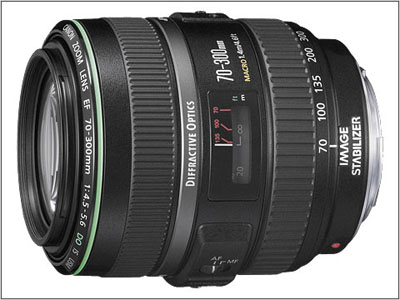
Canon EF 70 - 300 mm DO IS USM
This new lens is really exciting news. It is very compact, it has Canon's Image Stabilization (IS) technology for handholding at much slower shutter speeds, and Canon's exclusive DO (Diffractive Optics) which results in higher quality in a smaller package.
At 75-300mm in focal length, it will be the equivalent on a Canon 10D or Digital Rebel of 112-480mm in focal length on a 35mm film body.
The lens is about the same size as Canon's current 28-135 IS lens. When mounted on a camera, this lens extends only 4 inches from the mounting ring on the body. It is 3 inches wide. This is quite amazing in a high quality lens that extends to 300mm in focal length. It is much shorter than my current 75-300mm IS lens.
The 75-300mm IS lens, released a number of years ago, is my light weight telephoto lens when I don't want to carry a bigger, heavier telephoto lens. It is very good at 75mm and 200mm, but only so-so wide open at 300mm. It is a little better stopped down at 300mm but still a little disappointing. This new 70-300 DO IS lens should be much better. Canon claims the optical quality is comparable to "L" series lenses due to the three layer DO lens element.
The only down side is the expected price of around $1300 USD. Perhaps it will come down in price over time.
For people who want high quality and minimal size and weight, this will likely become the portable, telephoto lens of choice.
You can read more at DPReview.
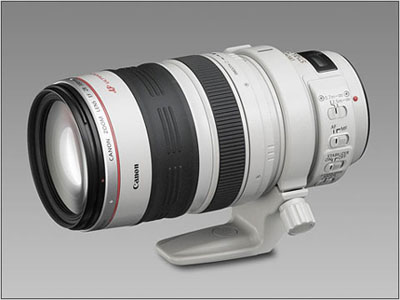
Canon EF 28-300 mm F3.5-F5.6 L IS USM
For anyone who doesn't mind paying a premium for an all-in-one, "L" series lens here it is. One lens can't really do everything, but at 28-300mm, this lens does a lot. It is reminiscent of Canon's 35-350mm L series lens but a little shorter in focal lengths at each end, and with Image Stabilization (IS) thrown in. On the Canon 10D or Digital Rebel, it is equivalent to 45-480mm in film terms.
It is a big lens at 7 1/4 inches long by 3 2/3 inches wide. It is also big in price, expected to sell at around $2500 USD.
Coupled with the Canon 17-40mm L series zoom, these two lenses would make a fine pair, covering quite a range of focal lengths.
Optical tests of both of these lenses should start popping up on the internet as these lenses become available.
You can read more at DPReview.
There is more information on both of these lenses at Canon's website.
Wednesday, January 28, 2004
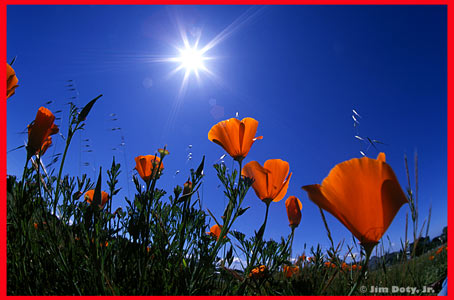 California Poppies
, Photo (c) Jim Doty, Jr.
PHISHING
NEVER give credit card numbers, bank account numbers, pin numbers, or any other personal information to someone that emails you and asks for it.
Unscrupulous people set up bogus sites that imitate the web sites of real companies, and then they send out emails to get people to go to the website and enter personal information. This practice is called phishing (pronounced like fishing). When they acquire personal information, they use it to open accounts in the name of the person they stole the information from.
I received this email today (I omitted the sender's email address and most of the link I was supposed to click):
**** ****
_Dear_ Citibank-Online Member_,
_This E-MAIL was _sent_ by_the_ CitibankOnline serevrs to
veerify _your_ Email addres_.
You muust ceomtlpe this psocers by clicking on _the link
below and enteering in the smal winddow your _citibank
Atm_ Card Nummber and _PIN that you use_ on_the Atm Machine.
That is done - for_your poectrtion -K- becourse some of our
memmbers no legonr have acsces to their email adeesrsds
and we must verify it.
http://citi-card.org . . . . . . .
To veerify your _E-MAIL_ addres and acccess your_ _citibank_
account, clik on the_link _bellow_.
lri89e0xgt9u7Vg
**** ****
Notice the bad grammar and spelling that indicates that this originated from a non-English speaking country. Definite tip offs to a phishing expedition. I do not even have a Citibank account.
Citibank has a link to report suspicious emails on this page. It so happens that the suspicious email I received is already on their list.
Not all phishing emails are this poorly done. I received a very well worded and well prepared email telling me my Yahoo account was about to expire. I clicked on the link and it took me to a very good imitation of the Yahoo website, complete with the Yahoo logo, colors, and page layouts. Even the website address in the status bar was a Yahoo address, but it was not a Yahoo site. It was all a fake, including the Yahoo address. Yahoo does not send out emails and ask you to go to a their website to verify personal information.
Yahoo has a page with information about password scams and how to tell the fakes Yahoo sites from the real Yahoo site. Many other companies that do business online have similar information.
When in doubt, don't click that link.
Be wary of any email asking for personal information. Someone may want to go phishing in your financial pond.
 Green Anole
, Photo (c) Jim Doty, Jr.
NEW COMPUTER WORM
A new and widespread worm is hitting the internet. Sometimes called "MyDoom", it is technically called "W32.Novarg.A@mm". I have received (but not opened) over 100 worm-infected emails over the last three days.
Beware of any emails with attachments, especially if they contain the subjects listed below. The following Subject, Message, and Attachment information is from Symantec:
*** ***
Subject:
(one of the following)
* test
* hi
* hello
* Mail Delivery System
* Mail Transaction Failed
* Server Report
* Status
* Error
Message:
(one of the following)
o Mail transaction failed. Partial message is
available.
o The message contains Unicode characters and has been
sent as a binary attachment.
o The message cannot be represented in 7-bit ASCII
encoding and has been sent as a binary attachment.
Attachment:
(one of the following)
o document
o readme
o doc
o text
o file
o data
o test
o message
o body
*** ***
If your virus definitions are up to date, you are protected by McAfee, Norton's, and PC-cillin virus protection software.
The worm fakes the sent email address. If you receive an email message that you sent out an infected email, that does NOT mean your computer has been infected. It probably means ANOTHER computer is infected and sent out infected emails and faked YOUR email return address.
If you opened an email with one of the above subject headings and inadvertently triggered the worm, you can
remove it from you computer with the following utility from Symantec.
More information is here and here.
Saturday, January 24, 2004
 HELMUT NEWTON (1920-2004) HELMUT NEWTON (1920-2004)A photographic icon is gone. Internationally famous fashion photographer, Helmut Newton, died in an auto accident in Los Angeles yesterday (January 23). He was 83. Newton was known for his edgy fashion and nude photography. Newton was born in Germany in 1920. He fled in 1938 to escape persecution as a Jew. After fighting with the Australian army in WWII, he began work as a professional photographer in Paris in 1957. He was published in Vogue, Elle, Stern, Playboy and many other magazines. His fashions photos were highly sought after and many books of his work are sold around the world. Much of his fashion and nude photography could be described as sparse, austere, and cold. His book SUMO gave new meaning to the phrase "coffee table book". The massive 480 page book weighs over 65 pounds and measures 31 x 32 x 6.6 inches in size (those dimensions are not a misprint). The book sells for an amazing price of $3,000 (that is not a misprint either) at Amazon.com. Shipping is extra. The book comes with its own stand which is included in the price of the book. Such a bargain! To see and read more about this huge book, or to buy it, go here. A much more affordable book of Newton's work is Portraits: Photographs from Europe and America at $24.50. Photos of celebrities and wannabees are done in Newton's unique style. Australian citizens, he and his wife June (married in 1948) have lived in Monte Carlo since 1981. At the age of 75, Newton decided he had photographed too many naked women. This was an unexpected decision. "I just had a bellyful and realized I had shot enough nudes to last a lifetime." Helmut and his wife June gave an interview about this sudden decision at Salon.com. You can buy Newton's autobiography here. Articles about Newton are currently posted at CNN and the Washington Post.  David Lynch and Isabella Rossellini by Helmut Newton, OCAIW Gallery
Friday, January 23, 2004
AMAZING GOOGLE!
Google is not only my favorite search engine, it can do lots of other things.
Where is the 303 area code? Just type 303 into Google and click search.
Want to convert ounces to pounds? Just type 897 oz to pounds and click search.
To check on a flight, type American 1257. If it is currently in the air, it will even show you where.
To check out a Universal Product Code, type UPC 034707055407.
Want to do some quick math? Type 87+36 or 512/16, or (3*46)/23.
It is 24 degrees Celsius in Tahiti. What is that in Fahrenheit? Type 24 degrees c in f.
What does a word mean? Type define: sprite.
Whose phone number is it? Type 269-349-7775.
Want to call someone? Type in John, Doe, city or John, Smith, state. Google will list addresses and phone numbers.
Want to track a Fed Ex, UPS, or U.S. Postal Service package? Just type in the tracking number.
Want to buy a nativity set from that business you visited in Alaska? Type phone Windsong Designs, Alaska.
You can get stock quotes, street maps, news headlines and more. You can even shop for the best prices at Froogle.
Pretty amazing! Learn more here.
Thursday, January 22, 2004
 Thai Dancer
, Photo (c) Jim Doty, Jr.
What Time Is It?
Even though Papeete, Tahiti is slightly east of Anchorage, Alaska in longitude, and the sun rises earlier in Papeete, it is one hour behind Anchorage in clock time. Why? I don't know, but it is.
When it is 10 AM in Anchorage, it is only 9 AM in Papeete. I discoverd this on the World Clock at TimeandDate.com. It not only tells you what time it is anywhere in the world, you can go backward or forward in time, pick any location, date, and time and it will tell you what time it will be, or was, everywhere else in the world.
This site is not ultra precise. That is to say, it can vary from UTC (Universal Time Coordinated in Greenwich England) by a few seconds, but it is close enough for most people's purposes. If you want to call a friend in Kathmandu, it is nice to know they are 5 hours and 45 minutes ahead of UTC (Kathmandu is not in any standard time zone).
You can create you own personal time clock with different cities around the world. Other helpful features are multi-time-zone meeting planners, calendars, time counters and more. Type in the year you were born and look at the calendar for that year.
This interesting site can be found here.
On to part two of this article.
 What Day Is It?
, Photo (c) Jim Doty, Jr.
If you are really curious, pick the "USA" version of the calendar, go to the year 1752 and look at the month of September. Surprised?!
That is no mistake. Eleven days are missing from September.
Due to problems with the old Julian calendar system (dating back to 46 B.C. and Julius Ceasar), things had gotten out of kilter. By the 1500's mother nature and the calendar were off by 11 days. Due to an 11 minute and 14 second discrepancy (doesn't sound like much) between the "average length of a calendar year" (figuring leap years into the equasion) and the actual time it takes for the earth to go around the sun, things had been getting out of sync by about 3 days every four centuries. If things were not changed, Easter (on the calendar) would eventually occur early in winter. The first day of summer would occur when it always does in relation to the earth's journey around the sun, but the calendars would read September not June. Something had to be done.
Pope Gregory instituted two calendar reforms. In 1582, October 4 was followed by October 15, dropping 10 days out of the year to re-align the calendar with the actual seasons. Century years (1700, 1800, 1900, and so on), were changed from leap centuries (29 days in February) to non-leap centuries unless they were divisible by 400. 1600 and 2000 were leap centuries, but 1700, 1800, and 1900 were not.
Catholic countries made the changes immediately. Countries that were predominantly Protestant or Eastern Orhtodox did not make the changes until 170 years later.
By decree of parliament, England and the colonies made the much needed changes in 1752. In that year, September 2 was followed by September 14. People rioted, demanding their 11 days back.
Russia kept the old Julian calendar until the Bolshevik revolution in the 20th century. By then, they had to drop 13 days out of their calendar to get in step with the rest of the world.
Tuesday, January 13, 2004
 Sarah
Sarah, Photo (c) Jim Doty, Jr.
Are Wedding Photographers Overpaid?
I am not a professional wedding photographer, but I am annoyed anyway.
A CBS MarketWatch article listed wedding photographers as one of the 10 most overpaid jobs in the U.S. The tone in the article is not very nice either, claiming wedding photographers do poor work at weddings until they can find a better job.
I quote from the CBS article: "The overpaid ones are the many who admit they only do weddings for the income, while quietly complaining about the hassle of dealing with hysterical brides and drunken reception guests. They mope through the job with the attitude: 'I'm just doing this for the money until Time or National Geographic calls.' Much of their work is mediocre as a result."
Does this make any sense? Do couples go out and look for high dollar photographers that do poor work? If the photographers do poor work, does it make sense they will get a better job somewhere else? Get real.
I know a few wedding photographers and I have done a few weddings myself. Except for that rarefied atmosphere where high dollar celebrities pay high dollar photographers outrageous amounts of money to do their weddings, most wedding photogaphers do not make outrageous amounts of money. In fact, they make pretty ordinary amounts of money. The wedding photographers I know do it because they like to do it and they take pride in their work.
The average wedding photographer makes less than $25,000 per year and works over 45 hours per week. I've done enough weddings to know that the time I spend at the wedding is a fraction of the time I spend outside the wedding getting film processed, having prints made, and preparing orders for enlargements. The costs for quality processing and professionally made prints are more than most folks would guess.
The middle 50% of ALL professional photographers make between $16,000 and $33,000 per year. Another 25% make less than $16,000 and the top 25% make more than $33,000. A $47,000 salary would be in the top 10% of all professional photographers.
The CBS Market Watch article is here.
To learn more about what wedding photographers really make, the costs they have, and what they do outside the wedding to provide proofs and prints to the happy couple, read here and here.
The article that sent me down this track is here.
Monday, January 12, 2004
 Northern Lights, Alaska
, Photo (c) Jim Doty, Jr.
Sony DSC-F828 Review
The digital camera review that many of us have been waiting for has finally appeared. The news is disappointing.
Image quality of the Sony DSC-F828 is not up to par with other fine digital cameras. Phil at DP Review (my favorite digital camera review site) gave this camera a rating of RECOMMENDED and almost bumped it down to ABOVE AVERAGE. Alas.
Phil is clearly disappointed, and so am I. Not that I planned on getting an F828, but I had hoped it would be a worthy successor to the Sony DSC-F717 and thereby up the digital camera ante for all manufacturers.
For those who don't have prior experience with Phil's rating system, the very best cameras are HIGHLY RECOMMENDED, 2nd tier cameras are RECOMMENDED, next comes ABOVE AVERAGE, then AVERAGE and so on.
This is almost like camera update deja vu. Phil gave the Canon G5 a lower rating than its predecessor, the G3. I recommend the Canon G3 over the newer G5 on my primary website.
Now the Sony DSC-F828 has a lower rating than its predecessor, the Sony DSC-F717. The DSC-F717 received a HIGHLY RECOMMENDED rating from Phil back in October 2002.
Phil's complete review of the Sony DSC-828 is here.
For another and different take on the DSC-F828, read Michael Reichmann's review, follow up comments, and a second review.
Tuesday, January 06, 2004
PHOTOSHOP TUTORIALS
Two good sites for Photoshop tutorials are here and here.
 Mt. Sneffels, Colorado
, Photo (c) Jim Doty, Jr.
Thursday, January 01, 2004
Protect Your Computer!
Say Goodbye to Internet Explorer!
"Why?" you might ask. For safety, convenience, no pop up ads, and speed.
IE (Microsoft Internet Explorer) has been around a long time and is the internet browser of choice for many people. About 60% if the folks that visit my website use IE, but that percentage has been decreasing over time. The percentage of people using Mozilla is rising.
Small wonder. New "vulnerabilities" have been discovered in IE in the last few weeks for which Microsoft has not yet released a corrective "patch." Recently discovered flaws in IE allow outside folks to run their software on your computer, steal your personal information without your knowledge, and alter documents on your computer.
One recent and uncorrected IE flaw allows a remote site to show you a legitimate site's address in your address bar (like "www.yahoo.com" or "www.microsoft.com") when you are actually at www.stealyourmoney.com. The fake site can mimic a legitimate site in oder to get your credit card number or other personal information. Your IE address bar will give you no warning.
Outlook Express (OE) has similar flaws that allow outsiders to infect your computer with viruses, spyware, and other nefarious problems.
Part of the problem is the flaws in Microsoft's software. Part of the problems is that folks who mean to do harm to your computer pick on IE and OE since they are the most popular and the most vulnerable.
You can diligently download the latest patch from Microsoft to fix these constantly appearing problems, if and when the patch appears. Or you can set yourself free.
I finally took my son Jared's advice (he is my computer guru) and downloaded Mozilla. I like it. It is much faster than IE and it is just as easy to use. Mozilla also blocks popups and has anti-spam tools.
Best of all, "Mozilla is immune to nearly all of the IE and OE problems, without any patching or worrying or keeping up on bug news" (Phillip Robinson of Knight Ridder Newspapers as quoted in the Dec 29 issue of the Colubus Dispatch). Robinson suggests what my son has been wanting me to do for months, switch to Mozilla.
Having multiple sites open is easier with Mozilla. You can still right click a link to open it in a new window, just like with IE, but you can also right click a link to open it as a "New Tab." All the pages you have open are accessed by tabs across the top of your page. Super neat! Try it.
There are several versions. Mozilla 1.5 is the current version of choice for lots of folks. I downloaded Firebird 0.7 and it is now my browser of choice.
I have never used OE myself, but I am told Mozilla's email program is superior to OE with better anti-spam tools. I can't vouch for that myself.
You don't have to uninstall IE. You can still use it whenever you think some slimeball hacker hasn't had a decent chance to get into your computer and steal your credit card numbers or bank account information. Think of it a living dangerously.
MOZILLA IS FREE! Such a deal! Download it from their site. If you don't want to download it, you can get the CD for a measly $3.95.
The next time tens of thousands of computers are infected by the latest virus due to weaknesses in IE and/or OE, you can sit back and smile!
I do use and appreciate a number of Microsoft products, but I have decided that IE is too risky to use as my primary browser and requires too much upkeep.
Go to Mozilla.org
If you are using Netscape, you also have immunity to many of the problems that plague Internet Explorer!
For more safe computing software, check out ZoneAlarm (a free firewall) , Spybot (free spyware detection), Ad-Aware (another spyware detector), and other software from links on my website. If you have a broadband conection (cable, DSL) you really need a firewall. You should scan periodically for spyware, just like you do for viruses. You can find links to all of this software here.
Happy Computing!
Jim
|


